
Choosing Paradiso
For the past fifteen years, Flat No. 2 on the 11th floor of Tower 17 in ATS Greens Paradiso has been home to us. When I look back now, the decision that brought us here feels less like a property purchase and more like the beginning of a quiet new chapter. It was around 2005, after we had slowly regained our financial footing following the losses we had suffered during our years in India, that the thought first began to take shape. We already had a house at 518, Sector 29, where my parents lived, but we were looking for a place that would be truly our own—close enough to them to remain connected, yet far enough to give us the independence and privacy we had grown used to. Having lived outside India for nearly thirty years, we were not very familiar with the changing property landscape of Noida and its surrounding areas. We had bought and sold properties before, often with good results, but this time felt different. We were not merely investing; we were searching for a home to which we could eventually return and belong. As luck would have it, our neighbour at 519, Sector 29, was Mr Getamber Anand—Joe, as he was fondly known—then an up-and-coming builder with only a couple of small projects behind him, but already carrying the promise of much bigger things. Today, of course, his company ATS Infrastructure is counted among the leading builders of the NCR region.
I had already invested in one or two ATS projects through Joe, so it felt natural to speak with him when we began thinking seriously about a future residence. Quite by accident, that conversation led us towards Greater Noida. Joe personally took us to one of his premium projects in Sector 93, Noida, and walked us through it himself. The project, ATS Greens, was nearing completion, and I still remember how beautiful it looked to us that day—fresh, spacious, and full of promise. We were convinced. Soon after, we booked a three-bedroom apartment of about 2,400 square feet at ATS Greens Paradiso, Greater Noida, which was then only just beginning to rise from the ground. We chose a construction-linked payment plan, partly out of prudence and partly because it allowed us to pay gradually as we earned, without emptying our reserves in one stroke. As the project progressed, however, another thought began to nag at us. What if, one day, our parents, children, and grandchildren all came to stay at the same time? Would the apartment be large enough for the kind of family life we imagined? With that picture in mind, we asked Joe if he could exchange our booking for a larger flat of about 3,000 square feet. He could now offer the larger flats only in Phase II, which was still in its infancy, under excavation in fact, but that suited us quite well. We had no immediate plans to return to India, and the extra time gave us both breathing space and the advantage of a lower price.
Preparing to Return
And so, over the years, we kept paying slowly while the building steadily took shape and neared completion. By 2010, as I approached my sixtieth birthday, the idea of returning to India was no longer distant or theoretical; it had become a firm decision. I was equally clear in my mind about one thing: I did not want to come back and look for a job. After three decades in Africa, my experience, rich as it had been, was not the kind that neatly fitted into senior corporate positions in India. More importantly, I wanted the freedom of a retired life—to wake up to days that were my own and to pursue interests of my own choosing. During the following year, things began to fall into place with surprising smoothness, and by September 2010 I was ready to return home.

Once the decision was made, we began coordinating with ATS for the final payments and for taking possession of the apartment. We hoped to complete enough of the renovation and interiors before our return the following year, so that, when we finally arrived, we would have a comfortable and ready place to settle into. We requested Gargi Khosla (second from left in the last row above), who is married to one of my cousins and is an excellent interior decorator, to take charge of the interiors. We asked her to furnish the three bedrooms, while the fourth bedroom—which I intended to use as my study and office—could wait until after we returned. The dining and living room furniture could also be bought later. For the moment, all we wanted was a welcoming, livable home: a place where we could park ourselves while slowly choosing the remaining furnishings and essentials such as air conditioners, refrigerators, and televisions as required. We told Gargi that we expected to be finally back in September 2011, almost a year away, and that she could therefore work at her own pace and convenience. She did an excellent job, one that we still admire and remain grateful for. It says much about her dedication that she spared no effort, sometimes even climbing eleven floors because the lifts in the apartment building were still being installed.
Settling In
After we moved in, one fine day, while we were still in the midst of settling down, Joe happened to come to the society. We were among the very early movers into Phase II , a lot of landscaping and infrastructure work was still going on and he had come for a site visit. He was the CEO of ATS, so his visit obviously caused quite a stir. I happened to notice him from our apartment and immediately went downstairs to try and meet him. He was really pleased to see me, and I invited him to come up and see our new home, a result of the efforts of his team. He admired the way we were settling in, and true to his generous nature, insisted on sending a full team of labourers to scrub and clean the marble floors of the apartment, even though we had already got this done once before. He also sent for the site in-charge and introduced us as family, saying that we were to be looked after properly and treated as VIPs. For the next few days, tea and biscuits arrived from the site office every few hours with such regularity that, touched as we were, we eventually had to request them to stop.
It was our first experience of living in a gated society, and to us it felt almost luxurious. In Ghana and Nigeria, we had spent years struggling with basic facilities and long power outages. Here, there was full DG backup twenty-four hours a day. In Ghana, I often had to wake up in the middle of the night to fill diesel in the generator set; here, that worry disappeared completely. There, we had frequently depended on tanker water and rationed it carefully; here, hot and cold water flowed from high-pressure taps as if by magic. There, security often meant untrained guards whose backgrounds we did not know and whom we still had to watch with caution; here, uniformed guards were stationed at strategic points and protected the entire property. Visitors were screened and our approval sought before being allowed to see us. For someone who had lived through those various uncertainties, the small certainties of this new life felt deeply comforting.
Life in the Society
What struck me most in those early days was the sense of space. ATS Paradiso spread itself over 32 acres, and much of that land seemed to have been given over not to concrete but to greenery. Palm trees, flowering plants, and carefully maintained lawns softened the edges of the buildings, and over time those lawns would become one of the society’s quiet pleasures. The three parks, jogging paths, and walking trails slowly became part of our daily rhythm. Below is a small gallery of some people, like us, quietly going about their morning routines. Clicking on an image will commence the gallery slideshow in fulll screen


There were 23 towers in all, modest by today’s high-rise standards, with only 13 floors each and about 1,000 families across the campus. Our own tower, like the other larger-apartment towers, had only two flats on each floor, and that gave us a welcome feeling of privacy. I came to value the fact that our flat was open on three sides. Sunlight entered generously through the day, and the cross-ventilation made the apartment feel alive rather than enclosed.
They say an Englishman’s home is his castle. For us too, Tower 17 is one of the best towers in the society. Ideally located, quite isolated from the traffic movement that continues through much of the day in the major lanes of the society. But besides the location, there is the camaraderie that has developed over the years between the residents, almost all of whom are owners, not tenants, so not likely to move out anytime soon. Most of us are going through the empty nest syndrome and we realise that in an emergency it is only each other whom we can count on. While the society itself organises several cultural programmes and festivals throughout the year, the 17ers additionally celebrate most festivals together. Holi is celebrated with a Lunch in the park in a potluck manner, with each person bringing in what they can cook best. Divali is celebrated at some body or the other’s apartment, complete with a fabulous dinner, drinks and of course Teen Patti. So also New Year. Other festivals like Lohri are also celebrated together in a very cordial and enjoyable manner.


There is also the clubhouse, an attractive swimming pool, a gym, the yoga room, and a small shopping centre for everyday needs. For many years I made regular use of some of these facilities, but what I remember most is not the list of amenities itself. It is the feeling that, after years of managing shortages and improvisations elsewhere, life here has acquired a certain ease.
Community Rhythms and Irritations
Some of my fondest memories of Paradiso are small morning scenes. Bird-feeding bottles have been placed by concerned co-residents at various points in the parks, and I often paused to listen to the chirping as the birds gathered for their meal. The smaller birds usually arrived first, then the larger ones, and whatever slipped to the ground was quickly claimed by squirrels. It was a simple ritual, but one of those ordinary sights that quietly attaches a person to a place. Here’s a small viedo clip of the experience
The parks also had their human rhythms. Groups of senior citizens gathered at different times of the morning, – some to gossip, some to talk, some to chant the Lord’s name and clap in devotion. On the manicured lawns one could see people practising tai chi or yoga, while the community laughter group added its own cheerful sound to the mornings. In summer, the swimming pool filled up with children, and it was pleasing to see people of all ages using the spaces in their own way.
Of course, no community is made only of pleasant scenes. Shared living brings its small irritations too. There were times when residents parked carelessly, and it was frustrating to return and find one’s own slot occupied by someone who should have known better. There were dog owners who did not always clean up after their pets, even in places where both rules and courtesy should have guided them. Stray dog feeding in common areas also caused concern at times, especially for older residents and children.
Yet these were part of the larger texture of living among many families. They reminded me that even the best-designed society depends, in the end, on the habits and consideration of its residents. Fortunately, such incidents never formed the main memory of Paradiso for us. They remained small blemishes on what was otherwise a very conducive and pleasant place to live.
The Wider Neighbourhood
Beyond the gates of Paradiso lay another story, older than ours. The land on which the society stands had once been farmland, where farmers grew rice and wheat on these plots. It was acquired by the Greater Noida Authority at an agreed price, which was duly paid. Some years later, however, the farmers began agitating for additional compensation. ATS maintained that it had already sold the flats on the basis of its original costs and could not go back to owners for more money, especially as many flats had already changed hands. The matter went to court and remains pending.
Because of this dispute, prices in ATS Paradiso did not rise as much as they might have. In later years, however, values began to appreciate, helped in part by the commissioning of the new Noida International Airport at nearby Jewar. The area also became better connected, with the Yamuna Expressway, the Eastern Peripheral Expressway, and the Noida–Greater Noida Expressway linking it to major cities. What had once felt like a distant edge of the city gradually began to feel more integrated and central to the region’s future.
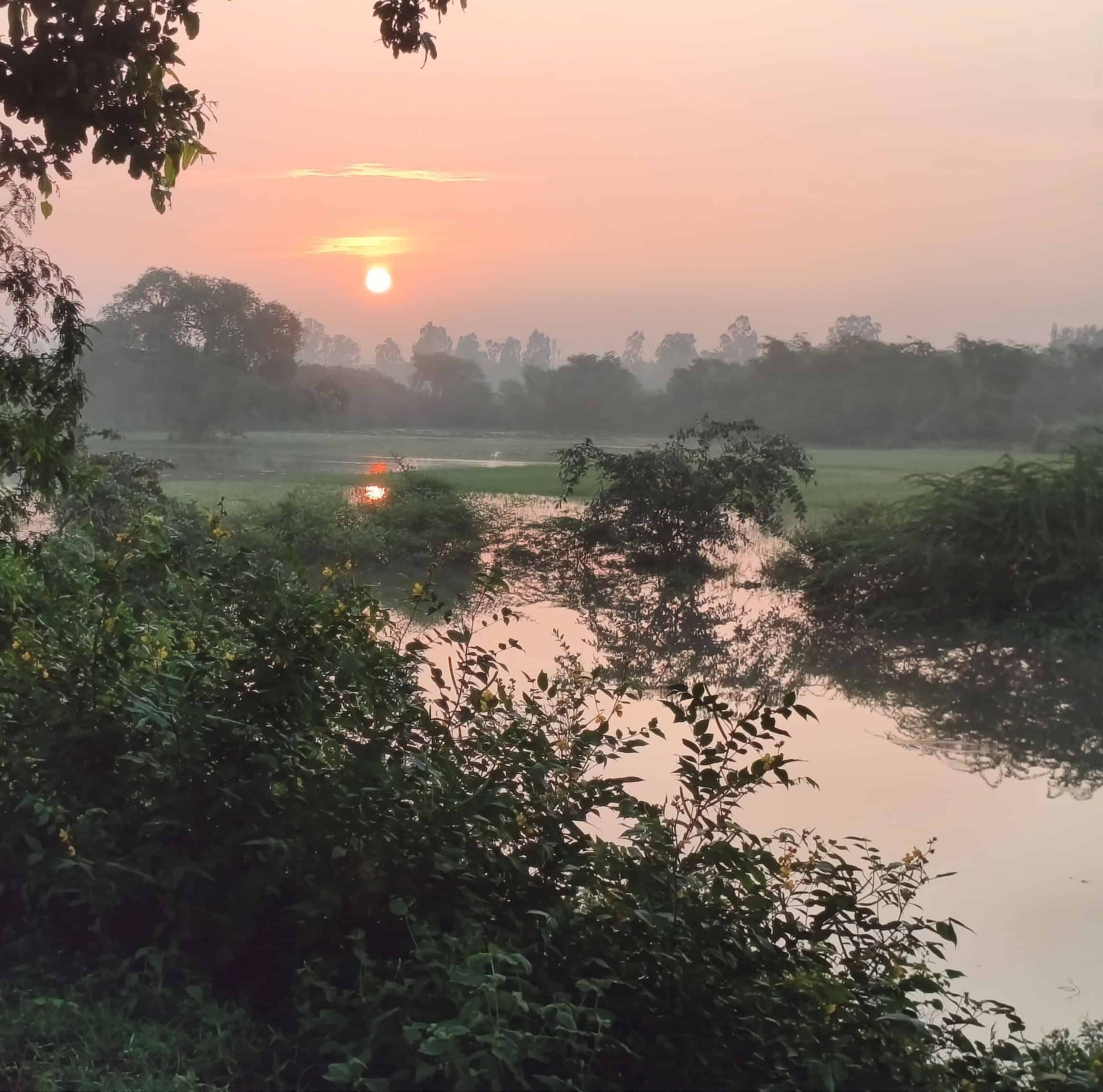
Paradiso also attracted a particular kind of resident. Several retired top level bureaucrats and senior military officers have made their homes here. Even though another nearby society had been created especially for army residents and has existed before Paradiso, many senior officers still seemed to prefer Paradiso because of its standing. Around us, however, the land still retained something of its agricultural character. In the growing season, the fields turned green, and although parali burning after the harvest could be a nuisance, the rural edges of the property had their own charm. We used to enjoy walking along the periphery watching the sun rise. On most days, peacocks were abundantly visible and nilgais (bluebuck antelopes) could often be seen grazing in the fields.



Inside our own home, we have tried to keep the style graceful but not showy. Much of the decor had come with us from Ghana—curtains, African-style fabrics, and furnishings that we had collected with this new house in mind. In that sense, the apartment was never only a return to India. It also carried traces of the life we had lived elsewhere, and perhaps that is what made it feel truly ours.
Of course, time has not been standing still either. I came across these pictures from 2016 when Tavish visited us. Here he is playing soccer with Tiny. Both he and the palm trees behind him have grown considerably taller in the ten years since.

The years at ATS have been good and may they continue to be so. Take a look at ATS over the seasons and the years


Excellent reading. Great decision.